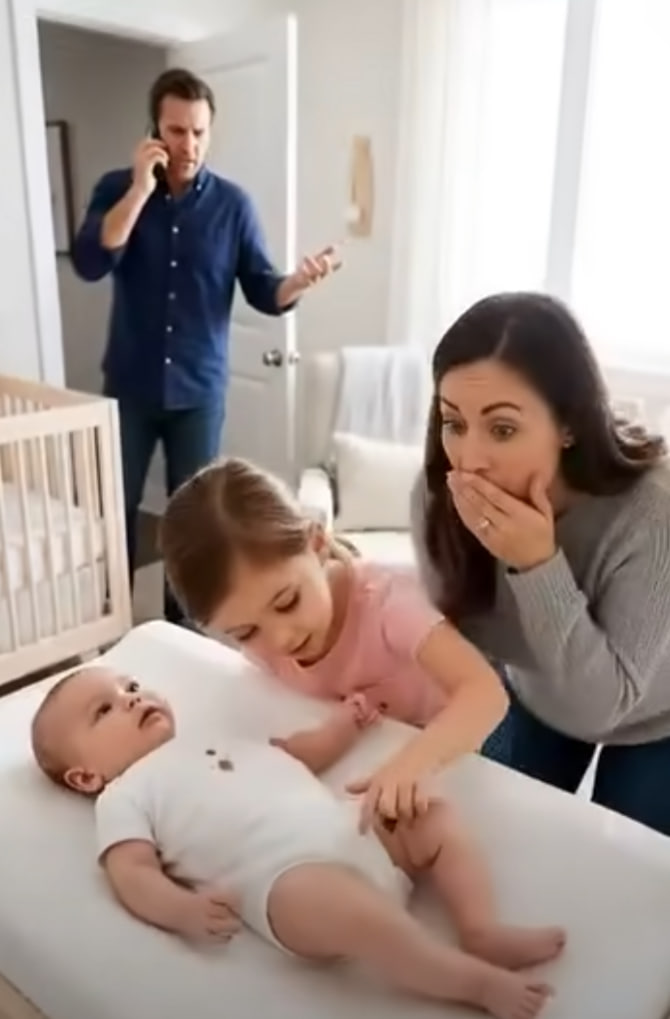
“MOM! LOOK!” my daughter screamed. I ran in to find finger-shaped bru/ises on my newborn niece. My husband took our daughter out and called 911. But when my sister, the baby’s mom, arrived, she wasn’t horrified. The investigator showed her the photos, and she looked right at me and whispered, “You weren’t supposed to see that.”

I have always believed that instincts are just the subconscious screaming what the conscious mind is too afraid to acknowledge. My instinct had been whispering to me about my sister, Heather, for months, a low-level hum of anxiety that I swatted away like a persistent fly. She was overwhelmed, I told myself. She was a single mother. She was tired.
But on that Tuesday evening, the hum became a siren.
I was babysitting my newborn niece, Emery. She was three months old, a tiny bundle of soft skin and wide, curious eyes that seemed to hold the secrets of the universe. Heather had dropped her off in a rush, muttering about a shift she had to cover at the diner, though she wasn’t wearing her uniform. She looked frantic, her makeup smudged, her eyes darting around my living room as if she expected the walls to close in.
“Just… thanks, Elena. I’ll be back by ten,” she had said, practically shoving the diaper bag into my arms before fleeing out the door.
I pushed the oddness aside. I had Emery, and that was all that mattered.
The evening was peaceful. My husband, James, was in the study, and the house was filled with the soft, ambient sounds of a jazz playlist I used to lull the baby to sleep. Around 8:00 PM, Emery spat up, a considerable amount that soaked her onesie.
“Alright, little bean,” I cooed, lifting her from the bassinet. “Let’s get you clean.”
I carried her to the nursery we kept set up for her visits. The room was warm, smelling faintly of lavender and talcum powder. I laid her on the changing table, unzipping the damp fabric. She kicked her little legs, gurgling a sound that usually made my heart soar.
I peeled the fabric away from her chest.
The world stopped.
The air left the room, sucked out by a sudden, violent vacuum of horror. My hands froze in mid-air. There, blooming across the delicate, pale skin of her ribcage, were bruises. They weren’t the faint, yellowish marks of a minor bump. They were deep, angry purples and mottled blues, shaped with terrifying precision.
They looked like fingerprints.
I couldn’t speak. My throat constricted, closing tight around a scream that refused to surface. I stared at the marks, my vision tunneling. No. No, no, no. My mind raced through a thousand innocent explanations, desperate to find one that fit. Had she fallen? Had I held her too tight?
But deep down, I knew. The spacing was wrong for a fall. These were grip marks. Someone had squeezed her. Hard.
“James!” The name ripped out of me, jagged and raw.
I heard his chair scrape against the floor downstairs, then heavy footsteps pounding up the stairs. “Elena? What’s wrong?”
He burst into the nursery, breathless. I couldn’t look at him. I couldn’t take my eyes off the infant who was now smiling up at me, oblivious to the evidence of cruelty etched onto her body. I simply pointed.
James stepped closer, his brow furrowed in confusion. He looked down. I saw the moment understanding hit him. His face went gray. All the color drained away, leaving him looking like a ghost. He reached out a trembling hand but stopped inches from her skin, afraid to touch her.
“Oh my God,” he whispered. “Elena… those are…”
“I know,” I choked out.
“We have to… we have to go. Now.” James’s voice shifted from shock to a terrifyingly calm command. He didn’t ask questions. He didn’t speculate. He acted. “Take her out of the room. Wrap her in the blanket. I’m calling 911.”
I lifted Emery with hands that felt like they belonged to a stranger. I was terrified I would hurt her, that even my gentle touch would aggravate the hidden pain she must have been feeling. She whined slightly as I settled her against my chest, and that tiny sound shattered me.
While James was on the phone with emergency services, his voice tight and clipped, I sat on the living room floor, rocking back and forth, clutching Emery. I needed to call Heather. I needed to tell her.
But as I reached for my phone, a darker thought seized me. What if she knows?
The paramedics and police arrived in a blur of flashing lights that cut through our quiet suburban street. They were efficient, clinical, but I saw the flicker of pity in the paramedic’s eyes as she examined Emery’s torso.
“We need to transport her for a full skeletal survey and observation,” the paramedic said gently. “Police protocol for injuries of this nature.”
“I’m going with her,” I said, standing up.
“Ma’am, we need to notify the mother,” the officer said, stepping forward. “Has she been contacted?”
“James called her,” I said. “She’s on her way.”
And then, Heather arrived.
This is the moment that haunts me more than the bruises themselves. When a mother hears her child is being taken to the hospital by ambulance, you expect panic. You expect hysteria. You expect a woman running from her car, shoes flying off, screaming her baby’s name.
Heather pulled into the driveway. She parked carefully. She checked her reflection in the rearview mirror.
When she walked through the front door, seeing the police, the paramedics, and me holding her baby, she didn’t rush to Emery. She stopped in the hallway, clutching her purse with white-knuckled force. She looked at me, then at the officer.
She didn’t look surprised.
“What happened?” she asked. Her voice wasn’t trembling. It was flat.
“We found bruises, Heather,” James said, his voice dropping to a dangerous growl. “On her ribs.”
She didn’t gasp. She didn’t cry out. She just blinked, her gaze shifting to the floor. “Oh.”
“Oh?” I stepped forward, fury igniting in my chest. “That’s all you have to say? Oh?”
“I mean… is she okay?” Heather asked, finally looking at the baby, but from a distance. She made no move to hold her.
“She’s being taken to the ER,” the officer said, watching Heather with narrowed eyes. “You can ride with her.”
Heather hesitated. “I… I can follow in my car.”
“I don’t like her face,” James muttered to me as the paramedics loaded the stretcher.
“What do you mean?” I whispered, watching my sister walk back to her car with a stiff, unnatural gait.
“She didn’t cry,” James said, clenching his fists. “She didn’t ask how bad it was. She didn’t ask who did it. Just… silent. Cold.”
He was right. She wasn’t acting like a panicked mother. She was acting like someone calculating her next move in a game she was rapidly losing.
As the ambulance pulled away, leaving us in the silence of the driveway, the officer turned to us. “You two need to come to the station. We need statements.”
I looked at James. The nightmare had just begun. But as I watched Heather’s taillights fade into the distance, I realized the monster wasn’t just the person who inflicted the bruises. It was the silence of the person who let it happen.
And I had a terrifying feeling that Heather wasn’t going to the hospital to comfort her daughter. She was going there to cover her tracks.
The waiting room of the hospital was a purgatory of fluorescent lights and hushed conversations. We weren’t allowed back with Emery. Only Heather. That rule felt like a physical blow. The woman who had looked at her bruised child with the emotional resonance of a statue was the only one allowed to hold her hand.
Time distorted. Minutes stretched into hours. James paced the length of the hallway, his boots squeaking on the linoleum, a metronome of anxiety.
“Why aren’t they telling us anything?” I whispered, staring at the double doors.
“Because we aren’t the parents,” James said, stopping in front of me. “Legally, we are nobody right now, Elena.”
At midnight, a doctor finally emerged. He looked exhausted, his face drawn. He wasn’t looking for Heather; he was looking for the detective who had met us there. They spoke in low tones near the nurses’ station. I strained to hear, catching fragments of sentences that made my stomach churn.
…non-accidental trauma…
…older fractures healing…
…grip marks consistent with…
James walked over, unable to help himself. “Doctor? Is she stable?”
The doctor looked at us, then at the detective for permission. The detective nodded slightly.
“Emery is stable,” the doctor said, his voice kind but firm. “She’s been admitted for observation. We’ve ruled out any underlying blood disorders or brittle bone diseases.”
“So, it’s definitely…” I couldn’t finish the sentence.
“It is physical abuse,” the detective finished for me. “The bruising is fresh, but the X-rays showed a healing fracture on her left clavicle. Maybe two weeks old.”
I covered my mouth. Two weeks. Two weeks ago, I had asked Heather why Emery was crying so much when I visited. She had told me it was colic. She had lied to my face while her daughter’s collarbone was knitting itself back together.
“Where is Heather?” James asked, scanning the room.
“She’s being questioned in a private room,” the detective said. “Her story… has inconsistencies.”
“What story?” I demanded.
“She claims she doesn’t know how it happened. Says she’s the only one who watches the baby. Says maybe she bumped into the crib.” The detective’s eyes were hard. “But grip marks don’t come from a crib, Mrs. Vance.”
James pulled me aside, leading me toward the vending machines, away from the prying ears of the staff.
“They’ll ask about the boyfriend,” James said quietly.
I blinked, confusion cutting through my grief. “Boyfriend? Heather is single. The father left before Emery was born.”
“No,” James shook his head. “She mentioned him a few times when she called me for money. Travis, or Trevor… I don’t know. She was vague. She said he didn’t like kids, so she kept them separate.”
“She brought a man who doesn’t like kids into a house with a newborn?” I felt sick. The pieces were clicking together—the frantic drop-off, the lack of uniform, the fear in her eyes. She hadn’t been working a shift. She had been with him.
The next morning, Child Protective Services (CPS) called us into a small, sterile conference room. Emery was officially in protective custody. Heather was not allowed near her.
And yes, the police had located the boyfriend.
“Travis Henson,” the social worker read from a file, sliding a mugshot across the table. The man in the photo had dead eyes and a sneer that made my skin crawl. “Thirty-three. Two prior assault charges. One involving a bar fight, another involving his own stepbrother.”
“He’s been living in Heather’s apartment for the last four months,” the detective added.
“We didn’t know,” I whispered. “She never told us.”
“We found texts,” the detective continued. “She texted him two hours before arriving at your house. The text read: ‘She won’t stop crying. I can’t deal with this. You need to go.’ And his reply…” The detective hesitated, then turned the paper so we could see the transcript.
Make it stop, or I will.
The silence in the room was suffocating.
“When we went to pick up Mr. Henson for questioning,” the detective said, leaning back, “he was gone. Cleared out his things from the apartment. No sign of him at his job site.”
Heather had claimed she hadn’t seen him in a week. But her phone records placed her at the apartment with him right before she came to us.
“The suspicion is turning toward her,” James said, his voice flat.
“She is currently a person of interest,” the detective confirmed. “Potential accomplice. Failure to protect. Depending on what we find, charges could be filed.”
I looked at James. “If Emery can’t go back to her… what happens?”
“You can request emergency kinship custody,” the CPS worker said gently. “Since you discovered the injuries and acted immediately to protect the child, you are in good standing. But it’s a process.”
That evening, we returned home to a house that felt too quiet. The nursery was empty. The crib stood like a monument to a failure I felt in my bones.
Then, a knock at the door.
It was faint, hesitant. James opened it.
Heather stood there. She looked like a ghost of the sister I knew. Her hair was matted, her eyes red-rimmed and hollow. She wasn’t wearing a coat, despite the chill in the air.
“I didn’t do anything,” she said. Her voice was thin, brittle. “It was him. Travis. I didn’t know it was this bad.”
“You let him live with you,” James said, blocking the doorway. He didn’t invite her in. “Around your newborn. A man with a violent record.”
“I didn’t know about the record!” she cried, her voice cracking. “I was tired, James! I was alone! He helped with the rent. He said he loved me.”
“You didn’t love Emery enough,” I said.
The words left my mouth before I could stop them. They hung in the air between us, sharp and irrevocable.
Heather turned a deep, blotchy red. She opened her mouth to scream, to defend herself, but then she crumbled. She collapsed onto our porch step, sobbing into her hands.
“I was scared of him,” she wailed. “He threatened me. He said if I told anyone, he’d hurt me too.”
I watched her cry. A part of me wanted to go to her, to hold my little sister. But then I remembered the bruises. I remembered the healing fracture. I remembered the text message: Make it stop.
“You brought her to us,” James said, his voice trembling with suppressed rage. “You brought her here because you knew he was going to kill her, didn’t you? You used us as a shield, but you didn’t have the guts to call the police yourself.”
Heather looked up, her face streaked with mascara. “I just wanted him to calm down.”
“Get off our porch,” James said.
“What?”
“Go home, Heather. Don’t come back until the police are done with you.”
She stood up slowly, looking from James to me. She saw no quarter in our eyes. As she turned to leave, she paused.
“Travis is gone,” she whispered. “He left town. They won’t find him.”
“They will,” I said.
She shook her head, a strange, terrifying smile touching her lips. “You don’t know him. He’s like smoke. But if they catch him… he’ll tell them everything. Things I didn’t do.”
“What does that mean?” I asked, stepping onto the porch.
She didn’t answer. She got into her car and drove away into the dark.
I turned to James, a cold dread coiling in my gut. “What did she mean, ‘things she didn’t do’?”
James looked at the empty street. “I don’t know. But I think we’re about to find out that Travis wasn’t the only one hurting that baby.”
The following weeks were a blur of court dates, interviews, and medical evaluations. It felt like we were living inside a washing machine—tumbled, drowned, spun around until we didn’t know which way was up.
Emery stayed in the pediatric care ward. We visited every day. She was gaining weight slowly. The bruises faded from purple to green to yellow, eventually disappearing from her skin, though I knew the memory of the pain would live in her body’s reflexes for a long time. She flinched at loud noises. She cried if she was held too tightly.
CPS launched a full investigation into Heather’s home life. The photos pulled from her apartment were damning.
They showed us the pictures in a small office at the courthouse.
The Crib: Cracked slats, repaired with duct tape.
The Floor: Unwashed bottles with curdled milk, empty cans of formula, piles of stained baby clothes mixed with men’s beer cans.
The Walls: A hole punched in the drywall, right above the changing table.
Heather tried to paint herself as the victim in court. Her lawyer argued she was overwhelmed, suffering from postpartum depression, and isolated. She blamed Travis for everything—the mess, the fear, the injuries.
But the prosecutor was relentless.
“Ms. Vance,” the prosecutor asked, pacing in front of the stand. “You admitted in your deposition that you suspected Mr. Henson was rough with the infant. Is that correct?”
Heather looked small in the witness chair. “Yes.”
“And yet, on the night in question, you left the infant alone with him for two hours while you went to buy cigarettes? Is that correct?”
“I… I needed a break.”
“You needed a break,” the prosecutor repeated, letting the words hang in the air like rotting fruit. “And when you returned, and saw the baby was distressed, you didn’t call 911. You drove her to your sister’s house. You delayed medical care for nearly an hour.”
“I was scared!”
“You were protecting him,” the prosecutor shot back. “Or perhaps, you were protecting yourself.”
Then came the bombshell.
The police had found Travis. He had been apprehended in a motel two states over. And, just as Heather had predicted, he talked. He was eager to cut a deal.
He claimed he had never touched the baby. He claimed the bruises were from Heather. He claimed he was the one who told her to take the kid to her sister’s because she was losing her mind.
It was a classic “he said, she said.” Two monsters pointing fingers at each other in the dark.
But the court didn’t need to decide who inflicted the specific bruise to make a ruling on custody. The negligence was irrefutable. The environment was toxic.
The judge looked over his glasses at Heather. “Ms. Vance, this court finds that you have failed to provide a safe environment for your child. Whether by your own hand or by allowing a violent individual access to your infant, you have endangered her life.”
Heather sobbed, her head on the table.
“Custody is hereby removed. Temporary guardianship is granted to the maternal aunt and uncle, Elena and James Vance.”
I felt James’s hand squeeze mine so hard my knuckles popped. We didn’t cheer. There is no victory in a family destroying itself. There is only relief that the destruction has been halted.
Heather looked at me as the bailiff led her out. Her eyes were empty craters. “You stole her,” she mouthed.
I shook my head slowly. “You gave her away.”
Emery came home with us two weeks later.
We converted the guest room into a proper nursery. We bought new clothes, safe formula, soft blankets. My older daughter, Lila, who had been shielded from most of the drama, was ecstatic. She treated Emery like a porcelain doll, patting her back during burps with the solemnity of a tiny professional.
The nights were long. Emery woke up screaming often, terrifying, blood-curdling screams that spoke of terrors she couldn’t name. We took turns walking the floor with her.
“It’s okay,” I would whisper into her soft hair at 3:00 AM. “You’re safe. No one is going to hurt you here.”
Gradually, the screams became whimpers. The whimpers became sighs. She started to smile again—a real smile, one that reached her eyes.
But the shadow of Heather still lingered.
She called once, a month after the verdict. James picked up the phone. I watched him from the kitchen, holding my breath.
“Hello, Heather,” he said, his voice guarded.
I couldn’t hear her side, but I saw James’s jaw tighten.
“Not yet,” he said firmly. “You need to finish the parenting classes. You need to complete the drug screening. You need to prove you’re safe.”
Pause.
“No, Heather. We aren’t keeping her from you out of spite. We are keeping her alive.”
He hung up. The phone clicked into the cradle with a finality that echoed through the house.
“She wants to visit,” James said, turning to me.
“Is she… okay?”
“She sounded high,” James admitted, rubbing his face. “Or drunk. She said she misses her baby.”
“She misses the idea of her baby,” I corrected. “She doesn’t miss the crying or the diapers or the responsibility.”
I didn’t hear from her for another month. I feared she was spiraling, that the loss of Emery had removed the last tether holding her to reality.
Then, one morning, I found a letter in the mailbox.
It was a plain white envelope. No return address. The handwriting was jagged, scrawled in blue ink that looked like it had been pressed down too hard.
I sat on the porch swing, the morning sun warming the wood, and tore it open.
Elena,
I don’t expect you to forgive me. I don’t think I can forgive myself.
Travis is going to jail. They got him on the assault charges and the text messages. He admitted to shaking her.
I wanted to believe him when he said he loved me. I wanted to have a family so bad that I ignored the devil sitting at my kitchen table.
I failed Emery. I thought I was doing my best, but my best wasn’t enough. I let love blind me.
I’m going to therapy. I’m in the classes. I’m going to try to fix what I broke inside myself.
I hope one day you can tell her I loved her. Even if I didn’t deserve to raise her.
Take care of my bean.
There was no signature. But I knew it was Heather.
I folded the letter and held it to my chest. Tears pricked my eyes—not for the sister who had betrayed us, but for the tragedy of it all. For the brokenness that cycles through families like a virus until someone is brave enough to build a wall and say, Not here. Not anymore.
I walked back inside. In the living room, James was on the floor with Emery. She was on her tummy, lifting her head high, looking at a colorful rattle he was shaking.
She let out a squeal of delight, pure and unburdened.
I placed the letter in a keepsake box on the high shelf, tucked away behind the baby books. I would keep it. Not for Heather. Not for me.
For Emery.
One day, years from now, when she is old enough to ask why she lives with her aunt and uncle, why her mother isn’t there at graduation or her wedding, I will tell her the truth. I won’t give her all the gruesome details, but I will give her enough.
I will tell her that she had a mother who was lost in the dark and made terrible choices.
And I will tell her that she had an aunt and uncle who stepped into the fire to pull her out.
I watched James tickle her tummy, hearing that precious, bubbling laughter fill the room where silence had once been a warning sign.
We chose her. And every day, with every bottle, every diaper, every sleepless night, we would choose her again.